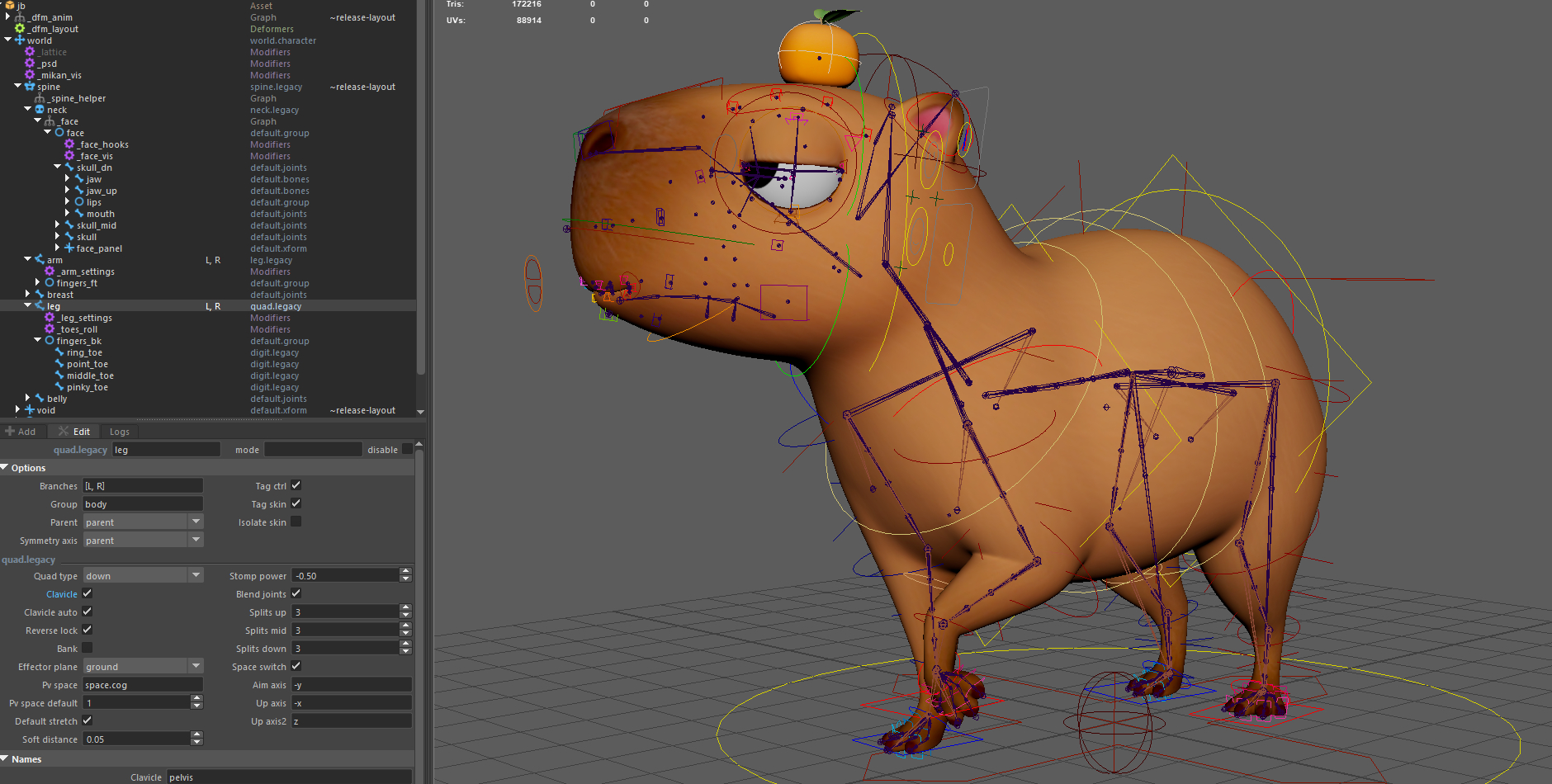
Mikan Rigging Framework
Welcome to the Mikan documentation.
Mikan is a procedural rigging framework developed for Autodesk Maya and Tangerine (TeamTO's high-performance animation platform). It allows technical artists to create robust, software-agnostic rig blueprints, from initial guide placement to advanced deformation setups, using a non-destructive workflow.
Core Philosophy
Mikan shifts the rigging paradigm from "building a rig" to "authoring a blueprint."
- Software-Agnostic Blueprints: Rigs are described as a hierarchy of standard DAG nodes and metadata. This blueprint can be exported natively as an Alembic file and interpreted by any compatible DCC.
- Non-Destructive Round-Trip: Mikan relies on a continuous
Template > Rig > Templateloop. You can build the rig, manually paint skin weights or tweak deformers, and instantly inject those changes back into the blueprint. You never lose manual work. - High Performance: The framework strictly generates modern, matrix-based hierarchies optimized for Maya's Parallel Evaluation and Tangerine's proprietary engine.
- Procedural Modularity: Using YAML-based modifiers, riggers can declare complex behaviors (like Spline IK, Muscle setups, or Spaces) dynamically, making components highly reusable across different assets.
The Authoring Loop
Creating a rig with Mikan is an iterative process. The blueprint remains your single source of truth.
- Assemble: Define the rig’s structure using
Templatesand add procedural logic viaModifiers. - Build: Mikan generates the fully functional mechanical rig (controllers, math nodes, constraints).
- Bind: Perform manual, geometry-specific deformation work directly on the built rig (e.g., painting skin weights, adding correctives).
- Inject: Push all manual changes back into the blueprint.
From here, you can safely delete the built rig, tweak your skeleton guides, and hit Build again. Your skin weights and custom logic will be perfectly reapplied.
Pipeline Integration
Because a Mikan blueprint is ultimately just a DAG hierarchy (exportable to Alembic or USD), it becomes a highly deployable artifact.
Using Mikan's lightweight Python API, technical directors can easily integrate headless rig generation into their studio's publish systems, batch scripts, or asset managers. The system natively supports Rig Variations, allowing a single blueprint source file to generate different rig levels (e.g., Layout, Animation, Crowd, FX) depending on the production's needs.
Prerequisites: Basic knowledge of Maya rigging (joints, matrix math, deformations) is expected to fully utilize this framework.
Next Steps
Ready to dive in?
- Check out the Installation Guide to set up Mikan.
- Follow the Quickstart Tutorial to build your first rig.
- Read about the Blueprint Anatomy to understand the core structure.