core.joints
Generates a simple FK joint chain rig module from a template chain.
Inheriting from base rig structures, this module allows building lightweight joint chains where you can choose whether the transformation hierarchy is driven primarily by joints or by control transforms. It is suitable for simple appendages, mechanical setups, or isolated bone chains that require customizable parenting and scale transmission behaviors. By default, the structure includes:
- A
rootnode - A controller (
ctrl) - A
skinnode (deformation output)
Structure
The module processes the template hierarchy as a continuous linear chain.
Depending on the chosen build options, the controllers can either form a continuous animation hierarchy or remain decoupled while delegating structural transformation and scale transmission directly to the underlying joints.
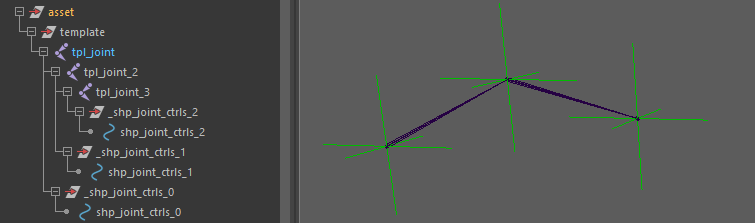
Parameters
Rig Hierarchy & Mode
| Parameter | Type | Default | Description |
|---|---|---|---|
type | enum | joint | Defines the underlying rig hierarchy type: - joint: All rig joints are parented under their respective roots, allowing clean scale transmission.- transform: Controllers form a continuous hierarchy, resulting in cumulative scaling behavior down the chain. |
unchain | bool | off | Prevents hierarchical parenting between generated controllers, breaking the continuous chain into unparented individual segments. |
Hierarchy & Nodes
| Parameter | Type | Default | Description |
|---|---|---|---|
add_nodes | str / list[str] | null | Injects custom buffer nodes into the node hierarchy. Use c as an anchor to define placement relative to the controller:- inf: Inserts inf_{name} above c_{name}.- [inf, pose]: Inserts both inf and pose nodes above ctrl.- [c, dyn]: Inserts dyn between ctrl and the skin joint. |
do_pose | bool | off | Convenience flag. Injects a pose node above the controller (ideal for driven key setups). |
Transform & Behavior
| Parameter | Type | Default | Description |
|---|---|---|---|
parent_scale | bool | off | Enables scale propagation between controllers by adjusting segment scale compensation between skin joints and roots. |
flip_orient | bool | off | Flips root orientation to produce symmetrical translation behavior on mirrored modules. |
rotate_order | enum | xyz | Sets the rotation order on the controller hierarchy (xyz, yzx, zxy, xzy, yxz, zyx). |
Outputs
Once built, the module exposes its generated DAG tree, node arrays, and attachment hooks for parent/child module interactions.
DAG Node Tree
The generated DAG hierarchy depends on the module's type parameter mode:
Joint Mode (type: joint)
To protect animator controls from unwanted scaling artifacts (e.g., scale applied on buffer/pose nodes), the DAG hierarchy is flattened. Transformation accumulation is handled via matrix connections rather than parent-child DAG nesting:
[root]
 └── [inf]            <-- Optional: injected above ctrl via add_nodes
 └── [pose]           <-- Optional: injected via do_pose or add_nodes
 └── [ctrl]
      └── [dyn]       <-- Optional: injected below ctrl via add_nodes
 └── [skin] (j.#)
Transform Mode (type: transform)
Generates a traditional, standard parent-child transform hierarchy. Only the final deformation skin node is built as a joint:
[root]
 └── [inf]            <-- Optional: injected above ctrl via add_nodes
      └── [pose]      <-- Optional: injected via do_pose or add_nodes
           └── [ctrl]
                └── [dyn]       <-- Optional: injected below ctrl via add_nodes
                     └── [skin] (j.#)
Node IDs
Node IDs are returned as arrays matching the number of segments in the chain:
<id>::roots.#: The top buffer group for each segment.<id>::ctrls.#: The animator-facing control curve (default shape: locator, color: limegreen).<id>::j.#: The structural rig joint, acting as the attachment point for child modules.<id>::skin.#: The deformation tag mapped directly to the generated joints.
Any custom buffer nodes injected into the hierarchy (via parameters like add_nodes or do_pose) automatically expose matching dynamic Node IDs. For instance, injecting a pose or inf node will generate arrays accessible as <id>::poses.# or <id>::infs.#.
Hooks
When another module is parented under this module during the template phase, connection hooks map to the following locations:
<id>::hooks.#: Mapped across all generated joints corresponding to the template chain (chain[:-1]).
Usage & Rigging Notes
Joint vs. Transform Hierarchy Modes
The type parameter changes how transformations flow through the module:
jointmode: Use this mode when clean segment scale compensation or independent joint behavior is needed. To protect animator controls from unwanted scaling artifacts (e.g., scale applied on buffer/pose nodes), the DAG hierarchy is flattened and transformation accumulation is handled via matrix connections rather than direct DAG parenting.transformmode: Uses a traditional controller-driven DAG parenting hierarchy where transforms, rotation, and scale accumulate naturally down the chain, with only the deformation node (skin) generated as a joint.
Unchaining Segments
Setting unchain to on disables automatic hierarchical parenting between consecutive controllers. Instead of forming a nested hierarchy following the template chain structure, all generated controllers remain independent and aligned in series.
This is a convenient way to generate multiple side-by-side controllers from a single module without needing to instantiate separate modules for each joint.
- Common Use Case: Rigging eyebrows. You can place a simple joint chain along the brow line in the template, and by enabling
unchain, you get a row of independent eyebrow controllers side by side.